Energy and precious metals are the backbone of modern economies and global stability. This Catalyst pillar equips leaders to understand how geopolitics, sustainability, technology, and resource innovation intersect across global energy systems and strategic materials markets — from lithium and rare earths to copper, platinum group metals, and gold — unlocking new opportunities in finance, manufacturing, infrastructure, and emerging technologies.
Today, these materials are no longer simple commodities; they are strategic assets essential to high-tech industries, defense, healthcare, financial systems, and global infrastructure. With fragile supply chains, rising regulatory demands, and intensifying global competition, mastering this domain is critical for navigating risk, securing long-term growth, and exercising entrepreneurial leadership in an increasingly complex world.


Medical innovation sits at the intersection of human impact, scientific discovery, and entrepreneurial leadership. This pillar equips participants to understand how healthcare breakthroughs move from concept to clinic — from regulatory strategy and clinical research to trial design, reimbursement, and commercialization — transforming patient outcomes and expanding access to care, especially for vulnerable and underserved populations.
Participants explore how emerging technologies such as gene editing, mRNA, artificial intelligence, regenerative medicine, nanotechnology, 3D printing, wearables, telemedicine, and virtual reality are reshaping diagnosis, treatment, and care delivery. As these technologies revolutionize global healthcare systems, leaders learn to navigate both the immense opportunity and the ethical, regulatory, and implementation challenges required to deliver safe, equitable, and scalable impact.
High-performing teams are the engine of sustained excellence, innovation, and competitive advantage. This pillar explores how exceptional teams are intentionally built, aligned, and developed — not by simply assembling top individual talent, but by creating the right collective composition. Drawing on leading research, including Herman Aguinis’s work, participants examine how strategic team design, performance management, and continuous development generate exponential—not merely incremental—performance gains over time.
Participants learn how elite teams emerge through deliberate alignment between individual strengths and shared purpose, supported by continuous learning, adaptability, and performance feedback. They explore how high-impact leaders place star performers where they generate the most significant organizational value, cultivate growth for emerging talent, and create environments grounded in fairness, opportunity, and trust. Through real-world cases — from business organizations to iconic examples like the 1980 U.S. Olympic hockey team — this pillar demonstrates that high-performing teams are not born; they are designed, developed, and sustained through disciplined leadership and intentional culture.


Strategic innovation is the discipline of leading organizations through complexity, uncertainty, and constant transformation. This pillar equips participants with the frameworks and mindset needed to navigate dynamic environments where traditional management models no longer suffice. Grounded in systems thinking and enterprise-wide integration, participants explore how strategy, culture, and structure function as a single, interconnected system — shaping organizational resilience, adaptability, and long-term performance.
Drawing on the principles articulated in Management in a Dynamic Environment, this pillar emphasizes holistic leadership and system-based decision-making. Published by Springer as an open-access volume, the book presents a comprehensive framework for understanding how managers and entrepreneurs can succeed in today’s rapidly changing business landscape. Through a system-based, holistic approach, Dr. Rico Baldegger, ICSB Board Member, bridges theory and practice, equipping leaders with the tools to manage complexity, drive innovation, and lead with purpose. As Dr. Baldegger captures it: “Managing in a dynamic world requires systemic thinking and human-centered leadership.” Through real-world case studies, reflection exercises, and applied learning, this pillar prepares participants to design and sustain innovation ecosystems aligned with human-centered entrepreneurship and global impact.
Artificial Intelligence — including Generative AI — is no longer a future concept; it is a present-day strategic advantage. This pillar transforms AI from a buzzword into a practical leadership tool, equipping participants with the frameworks, confidence, and insight needed to compete in an increasingly intelligent economy. Led by Skye Blanks, GW Presidential Fellow, the pillar delivers cutting-edge perspective on how AI is reshaping modern enterprise.
Participants develop strategic awareness of AI and Generative AI adoption — from cost-effective implementation and realistic expectations to avoiding the pitfalls that derail transformation. They then apply AI across finance, automation, and global markets, exploring inclusive credit models, AI-powered financial services, intelligent business infrastructure, and cross-border growth. Through case studies, collaboration, and a hands-on mini project, leaders design their own AI-powered business strategies — prepared to harness intelligent technologies responsibly for innovation, resilience, and long-term competitive advantage.

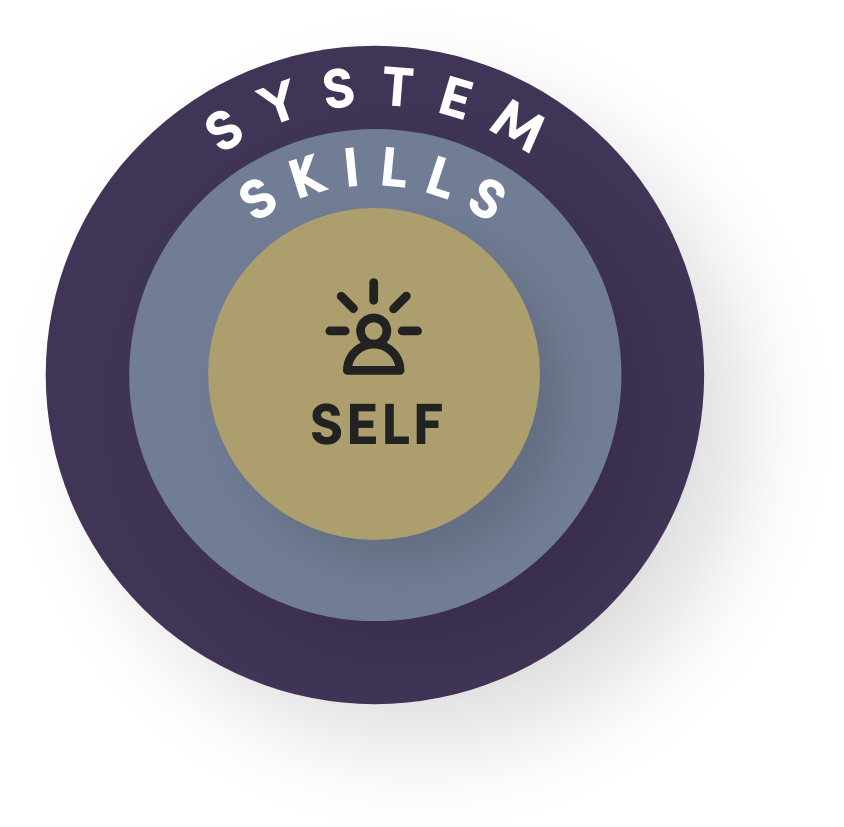
SYSTEM
Understanding complex global ecosystems — markets, technologies, institutions, geopolitics, and industries.
SKILLS
Mastering the tools of leadership — strategy, finance, innovation, AI, teamwork, and execution.
SELF
Cultivating the leader within — purpose, ethics, resilience, emotional intelligence, and growth.